Background

Showing posts with label suspense. Show all posts

Monday, September 26, 2011

Across the Universe


I have heard a lot of gushing over quite a swath of time about Beth Revis's novel, Across the Universe. I mean, a lot.

I heard it's a gorgeous blend of mystery and science fiction. I heard it's heart-rending. I heard the potential love story hits hard. I heard the world-building came through both lush and realistic (for a futuristic spaceship).

I don't think it was good for me, hearing all that ahead of reading the book for myself. I found the mystery mediocre, and disappointingly easy to figure out far ahead of the characters. Maybe I was meant to, I don't know. The descriptions of the ship were good, and somewhat disgusting, in a way I appreciated (though if I'd read the word "relish" in any of its forms again, I could have growled). The love story appealed to me more from Elder's viewpoint than Amy's, but I suppose that also makes more sense, as Elder was far more into it, not being in the midst of a familial crises the same sort as Amy's.

All-in-all, I think I'd just expected too much from the book and when I concluded it was only "pretty decent", I felt let down. It annoys me I have to make an excuse for my opinion. It annoys me I have to review it on a curve, so to speak.

Some people will love this book. It will be everything they want. It, unfortunately, was not for me. Read the cover blurb, read a couple of pages in the middle, then decide for yourself if it's worth a Buy or a Borrow.

Sunday, September 18, 2011

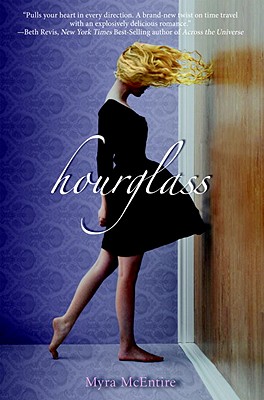
Hourglass


I absolutely adore the cover of Myra McEntire's debut novel, Hourglass. Not only does it have lovely, smooth lines, but for a little while it fools you into thinking the model is being sucked into something . . . and then you realize it's actually a girl, standing on the wall, with gravity obeying its natural course. Go 'head, turn it on the side, and then try to decide what photo magic they used to pull that one off. Photoshop? Wires? Giant wind machine? TIME TRAVEL?

Oh, right; that's what the book's about. Or more accurately, things of the past visiting a quite present Emerson Cole. Or maybe they're ghosts? Maybe Em's psychic and sees dead people? Whatever the answer, the situation is trippy.

Enter the uber-hot Michael (such a popular name for uber-hot characters). Tell us what he wants, what he really, really wants. What's he need, that Michael boy? History rewritten, that's what. Also? Em, because they are science-fictionally two halves of one whole. But do they belong together? Maybe. Maybe not. Because, you see, there's someone else in Emerson's future . . . 

The cover blurbs suggest the book induces all sorts of mood swings in the reader, and this is true, especially in the final fifty pages. Even I, a "first hero met should get the girl" loyalist, don't completely root for one boy over the other by much. Even I can see the wisdom and merit of a specific someone else winning that war, other than Michael. McEntire has done a fantastic job forcing me to consider the alternative, without embittering me toward it. That takes some mad skills, to sway a girl like me. I can only admire it and hope to learn from it.

I say this with a bit of a admission: Hourglass is a book . . . how to put this? Well, sometimes I felt myself reading a scene or a bit of narrative and feeling either proud or a little wary, because it's written so much like I myself would have written it. So that may mean I'm biased when I say I think either a Buy or Borrow appropriate.  The book isn't the most prime example of fantastic writing ever known to man, but it's entertaining, an emotional rush, and leaves you thinking about it hours later, which means it delivers on exactly what it promises.

Tuesday, August 30, 2011

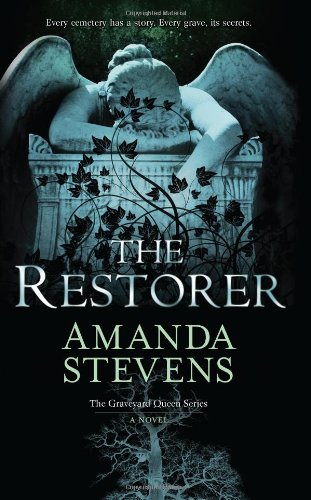
The Restorer

The Restorer (Graveyard Queen #1)
★★★¾

The Restorer by Amanda Stevens

As I've mentioned before, I'm a sucker for a good ghost story, even when it scares the schnikeys out of me.  The Restorer is one of those creepily good stories that goes for the perfect chilling factor.

Book one in the Graveyard Queen series (doesn't that just sound so awesome?) introduces us to Amelia Gray, a cemetery restorer who sees ghosts. These aren't Casper-friendly ghosts, either. These are scary, wet-the-bed nightmarish ghosts, so Amelia has held to her father's edict to never let ghosts know she can see them. She's done a good job—until now.

How could a ghost story get even better? Add in genteel Southerns entrenched in secret societies and sacrificial murders, plus a handsome potential love interest with a mysterious past, and you've got a realistically fright-worthy read.

While this book is published by Harlequin, it focuses more on the mystery than the romance, which I really appreciated in this story. I'm definitely looking forward to the sequel.

Thanks to the publisher and NetGalley for an advance copy.

Monday, August 22, 2011

Mister Monday


Okay, so I'm going to be easy like Sunday morning and just say, I really dug Garth Nix's Keys to the Kingdom starter, Mister Monday. I'm not saying it's my favorite book ever, but I definitely enjoyed the atmosphere, which I think compares to a bit of Neil Gaiman's Neverwhere smooshed together with Diana Wynne Jones's Chrestomanci books i.e. stark children's adventures with a no-holds-barred take on a young hero's lack of limitations.

Nix excels at creating a completely credible kid hero, Arthur Penhaligon. Arthur is a normal kid, not some super-powered, hyped-up X-boy. His power comes from the strength of his heart and his will. He has no ego to speak of, but is also not a whiny baby. He's comfortably aware of his limitations, but he's also aware of his loved ones and those who loves, and for them he's willing to believe and attempt anything, including wrest control of a creation dimension from its erstwhile caretakers.

With an unofficial, way-before-its-peak form of Steampunk, Nix has blended ephemeral magic with shiny, creepy and/or glorious mech, and a fantastic set of primary and secondary characters.

I'm looking forward to the next book, Grim Tuesday, and if I hadn't borrowed Mister Monday from the library in the first place, I'd have BOUGHT it. Knowing how much I like the first book, I might have to go pick up both of them.

Thursday, August 18, 2011

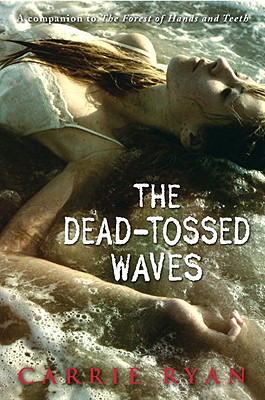
The Dead Tossed Waves


in·de·ci·sive
Function: adjective
1 : not decisive or final <an indecisive battle>
2 : finding it hard to make decisions <an indecisiveperson>

fick·le
Function: adjective
: likely to change frequently without good reason :<fickle friends> 

    un·sym·pa·thet·ic

    adjective /ˌənˌsimpəˈTHetik/ 


    1. (of a person) Not friendly or cooperative; unlikeable
      • - a totally unsympathetic character


Before I get started on the current book review, let me just say I loved Carrie Ryan's debut novel, The Forest of Hands and Teeth. LOVED. As many other readers, I was completely taken with the emotionally horrific tone that relied on heartbreak and bleak outlooks rather than gore or mindless terror. The book perfectly captured the subtlety and true frights of a nightmare world, and--in my opinion--settled in the same strata as Stephen King's more thriller-oriented offerings such as his Dark Tower series and his cult classic, The Talisman (a personal favorite of mine).

One doesn't have to have read Ryan's Forest to engage with its companion novel (set some fifteen-ish years later), The Dead-Tossed Waves. In fact, not having read Forest might be considered a perk, as the first 300 or so pages of Waves so closely mirrors its predecessor, they could almost be the same book. Swap some names around, tweak the setting, and voila! They're interchangeable.  Or, if you need a visual aid, please refer to Mr. Swayze's version of this point:


Thank you, Patrick. Second verse, same as the first, indeed!

All that aside, the reasons for the definitions above. They describe my main impressions of the narrator and main character, Gabry. While the writing style--with the exception of some places I felt tried too hard--holds up in quality to Ryan's first offering, the things that kind of irked me in Forest have returned in Waves to explode into full-on loathing. In the two-or-less weeks of Gabry's story she waffles between "loving" two boys, wanting and not wanting a different life, being petulant or dismissive of things she doesn't appreciate, and cowardice and courage . . . sometimes within minutes of each other. She wants Boy A she's known her whole life, no, wait, she wants Boy B she just met and who keeps freaky company. No, no, Boy A is going to kiss her! She wants him! No, Boy B, who's just brushed her hand with his!  She wants to stay safe in her little village. She wants to escape her little village. She wants to live/ there's no point to living anymore!

What's meant to create conflict, suspension and a sense of always being on the cusp of something epic only irritates and makes Gabry seem like one of the most stupid girls on the planet. Are we supposed to think the mind of a post-Return youth is conditioned towards such blatant abuse of free will? That people are so desperate they'll clutch at whatever is closest to their grasp, just like the constantly-moaning, constantly hungering Mudo? I don't. But then, my loyalty streak is as wide as my stubborn streak.

I will put this in the positive column, however: I very much enjoyed the addition of a certain sect of deviant characters. I won't spoil anyone with how or why I say 'deviant', but I don't mean it in the pop-culture sense of the word, but the traditional meaning. I thought their inclusion was a very nice foil layer, and their actions went far to ensure some doubt about the mental state/noble motivations of one of the potential suitors. Niiice.

Unfortunately, that admiration isn't enough to get The Dead-Tossed Waves out of a Bypass. Sorry.

Tuesday, August 16, 2011

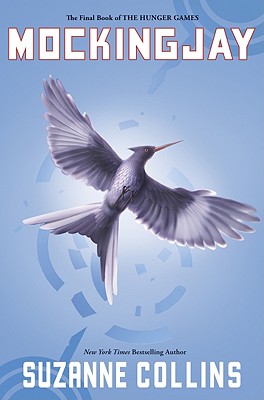
Mockingjay


Spoilers annoy me; I avoid them like the plague. Sometimes you get blindsided by them, though. I heard a few  of the most gut-wrenching details from Suzanne Collins's final Hunger Games novel, MockingJay before I managed to read it, which sucked out some of the impact the book had on me.

Still, I really enjoyed it. The end fulfilled the potential the series had built up. It had a certain exhausted poignancy about it. The brilliant character development begun in the first two novels carried through to a nice conclusion, the tone of setting changed without losing the tone of the first or second novels, and all in all, Collins rocked it, and like any truly empathetic story, readers either love or hate how it all turned out. Either way, passion is assured, whether they feel the final chapters of worthy their dedication or a betrayal thereof.

If you are one of the few book people not to hear of and/or read this book already, or are a non-book person who reads a book a year, I say you get your hands on the full series, including BUYING Mockingjay. It's earned a re-read, whether you're a "young adult" or not.

Tuesday, August 2, 2011

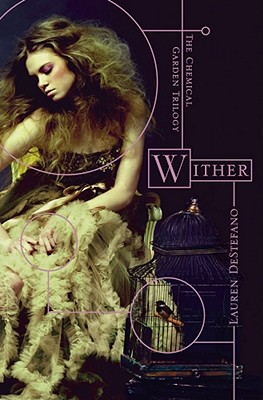
Wither


Lauren DeStefano's debut novel is A Good Book . . . and a Bad One, as well, but before you get all huffy on me, let me explain. Wither has a very odd sort of appeal, but it's strong. While reading it I had visions of The Stanley Hotel from The Shining, because the place narrator Rhine ends up gives  me the same sort of grand heebie-jeebies. The fact I felt and saw Rhine's world and the other people who inhabit it so thoroughly is a definite testament to DeStefano's world- and character-building skills The word "thick" also comes to mind like a really great blanket that doesn't let in any light, or cold; the essence of the story world completely encases you, but like any really efficient blanket, it's not entirely comfortable when it's so completely wrapped around you. But Wither *makes* you like it.

A stark story told in a crushingly luxurious setting, Wither is told in first person, allowing the reader to feel all of Rhine's rage, to be right there with her as she develops her particular brand of inner strength, dignity, and determination, her lessons in the differences between true malice, defensive measures, and simple idiocy.  And of course, we're very, very close as she quietly learns about falling in love, all the while feeling the constant-though-sometimes-whispered desperation in her every thought and action.

The book does exactly what a well-behaved book should, and with great results, and even though the cover makes it clear it's the first of a trilogy, I felt such satisfaction with the conclusion the book could be a stand-alone and still feel finished.  Hence, it is a Good Book (as in, well-behaved, like I said).

But I also said it was a Bad Book, didn't I? Why, when I enjoyed it so much?  Well, because it'll make you cry, if you're a writer. Especially if you're a writer. Because no debut author has a right to be this good, and reading Wither is bound to make any other novice/writer-hopeful feel completely inadequate.  Bad, Bad Book!

We should make it stand in a corner and think about what it's done.  But of course, we'd have to BUY our own copy, so our bookstore, friend, or library wouldn't get very angry if we just kept theirs.

Wednesday, July 20, 2011

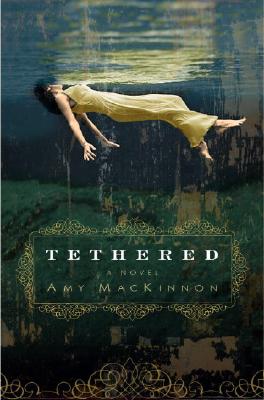
Tethered


There are few books that have done to me what Amy MacKinnon's Tethered has done, which is to take me through a solid, somber tale, leading in a very certain direction and with an expected pleasurable conclusion and then blow it all to hell in the last five pages.

What I thought was going on? Not even. Going back and checking details against what really was happening? Makes TOTAL sense. All of it. A retro "ah-HAH!" moment, or rather, a barage of them, because it was great, and it all fit together like a thousand-piece jig-saw.

And I can't even tell you anything specific about the brilliance, because as River Song would say, "Spoilers!" I suppose I'll need to keep it simple, then.

The narrative--from the perspective of Clara, a withdrawn, somewhat broken undertaker--has a quiet, steady pace, calming even with the often disturbing subject matter. It isn't that Clara regards these things with any sense of flippancy, rather the opposite; her ability to process grief is so underdeveloped it's as if tragedy slides right off of her, until a certain little girl gets under Clara's skin and Clara becomes concerned with the child's home life.

Before it's all over, just about every (living) person in Clara's life is somehow connected to the young girl's circumstances: The compassionate couple who run the funeral home where Clara works, and who consider Clara their child; the older detective assigned to the little girl's case; the younger officer eager to help solve it; and not a few of the former residents of the bodies Clara works on.

Maybe I should have paid closer attention when I put a hold on Tethered with my library, because the novel is labelled "suspense", which might have given me some better idea of what was coming, but then again, maybe not. All I can say about it was that it was awesome.

So, do I recommend you buy Tethered or do I suggest you just borrow it? Well, that depends. How much do you love suspense novels? Are you the kind of reader who appreciates the craftsmanship in a good mystery enough to read it again, even after the mystery is solved, or not? If so, BUY, if not, BORROW. Either way I expect you'll enjoy yourself.