Background

Showing posts with label Borrow. Show all posts

Thursday, January 12, 2012

Clockwork Prince


Somewhere in my brain, I'd already reviewed Clockwork Prince, the second book in Cassandra Clare's THE INFERNAL DEVICES (prequel series to Clare's hugely popular THE IMMORTAL INSTRUMENTS series), but maybe I just dreamed that, or maybe my brain referred to me mentioning the absolute hot-boyness of cover character James "Jem" Carstairs . . . because I would definitely have mentioned it, trust me.

But I guess, I didn't, and far be if from me to argue with the Libri Ago archives.  So! On with the review!

Needless to say, I bought the book. I'd have bought the book if I hated it, just for that cover, and buying it story-unread is next to the same thing, there's proof.

However, I did enjoy the story, though as is often the case, it took me a little while to get over my personal distaste regarding Clare's style of narrative. I generally love her dialogue, but many a narrative sentence is mentally tightened, de-passive-voiced, or unrepetitivized (yes, I'm making up words; I'm allowed) whilst I read. Also, as seems par for the course with a Clare book, the things I loved, I loved, but the things I disliked, I really disliked, so for the sake of keeping things straight, I'll divide the two.

Loved:

*Will's vulnerability and subsequent hope. In the beginning, we only know Will's main goal in life seems to make himself appear utterly unlikable, forget lovable. We find out why, and we also find out that even though Will is forced to play the game with certain parameters, he's by no means given up changing things.

*Jem's fragility, backed by optimism. The boy is dying, and yet, he keeps himself open to the happiness to be had in his short life. Of course, the fact that Jem is so very good makes me suspect him of every foul betrayal in the world, but we'll see. Maybe Clare will cut us a break.

*The revelation that husband and wife actually love one another very much, and have been victims of miscomunications.

*A certain warlock. 'Nuff said.

Disliked:

*Tessa's fickleness. I don't care if she's the heroine. I don't care of she's not entirely human, or if she's under a lot of pressure, or if yes, her choices of love interest are particularly amazing, I cannot buy her having the same intensity of feelings--especially physical--for both Will and Jem. Sometimes I felt as if I should see her being more drawn to Will, but it was a weakly written bit. I make no secret of it. I don't like Tessa, and I don't think she's a very well-developed character.

* Jessamine, but that's a no-brainer. How any girl could be that naive voluntarily . . . sheesh.

*Like I said, the narrative, which is sometimes wont to wander over hill and dale.

In general, the book definitely hit-it-off better with me than the first TID novel, and has accomplished garnering my interest in the conclusion, Clockwork Princess. I said of Angel, if you bought the other Clare books, buy this one out to complete your set. if you didn't, make use of you library card, and enjoy!

Tuesday, November 22, 2011

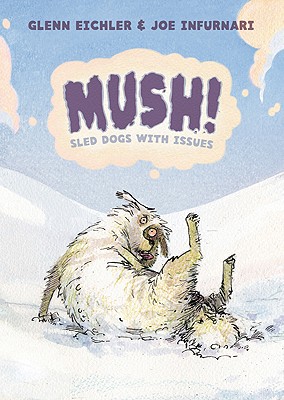
MUSH!: Sled Dogs with Issues


Glenn Eichler and Joe Infurnari either have a whole lot of time on their hands, or really, really well-developed senses of anthropomorphic intuition because MUSH!: Sled Dogs with Issues is a graphic novel that--if you could read it with your eyes closed--comes off kind of like The Office: ALASKA!, with a little of Mrs. Frisby and the Rats of NIMH thrown in.

Reading the description on IndieBound, it's clear why this might be a no-brainer. Eichler is a writer for the Colbert Report, while illustrator Infurnari does more than draw dogs; as a dog-channeler he also draws forth dogs' thoughts. (I confess I'm not sure what this means, but I don't think it involves Scooby Snacks and animal print turbans).

While MUSH! didn't strike right every chord, it hit enough of them properly for my half hour in the heads of snow-bound running dogs to be mostly pleasant. Eichler packs each narrative (Guy's resentment, Dolly's insecurities, Venus's bitterness, and Fiddler's ennui, plus a couple others) a little two tightly into the snow, but aside from a bit of over-analysis each problem entertains and creates realistic and sympathetic personalities. Infurnari's sketches (as may be seen from the cover) achieve the same sort of character with an amount of sparseness other, more detailed illustrations do not, and while again, not my preference in style, get the job done!

I'm not sure what the humans were doing in the story, as the only thing I can assume their flat plot line is meant to accomplish is providing a mini-breather--a kind of palate cleanser--between each transition from one doggie drama to the next. Or perhaps the creators wanted them as a foil against which to compare and contrasts the beasts humanity to that of actual humans. I could have done without it, or with some alternative mechanism.

At any rate, I doubt readers will be able to simply Borrow an indie title like MUSH! from smaller libraries, and at around thirteen bucks for 128 pages it's difficult to think all but graphic novel afficianados will consider the purchase price a "deal". Still, if you're lucky enough to live within a reasonable distance of a library or friend in possession of MUSH!, and you're a fan, by all means, get your paws on it for the time allotted.

MUSH!: Sled Dogs with Issues is available for purchase as of December 6th, 2011, and is currently available in pre-order at multiple book retailers, including IndieBound.

Wednesday, November 9, 2011

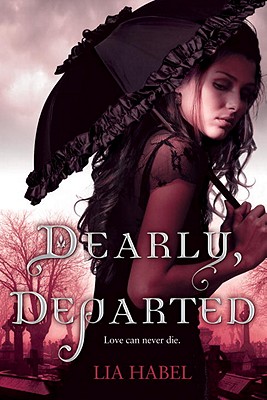
Dearly, Departed


NetGalley has the author of Dearly, Departed as LISA Habel, but I'll go out on a limb and bet the novel's lovely and dark cover has the right of it with LIA. You with me?

Mulitple author identities aside, I greatly enjoyed my first encounter with a Habel work. Released just this month, Dearly, Departed (yes, comma intentional)  encompasses the stories of a group of people, chaptered through their individual viewpoints, which range from disenfranchised post-apocalyptic "New Victorian" misses who miss natural propriety by a wide margin, all the way to military-approved and maintained undead with more heart (even if its entirely static) than the average high-class NV resident, with several types of character between.

So what happens if the world goes to hell in a natural-disaster-fiber-woven basket? It seems people regroup in more southerly climes, and a couple centuries later nothing really changes . . . well, except for The Lazarus  (or Laz) virus. The world still experiences class disparity, disagreements in political strategy,  and disputes regarding the place of technology. The world is the world.

At least, until Miss Nora Dearly--daughter of famed medical scientist Victor Dearly, deceased for the past year--becomes the Winner's prize between two contestants: First, the folks who know about the Lazarus virus, which reanimates a dead body to varying degrees of sanity and retained humanity, and want the government and someday the world to differentiate between the slobbering masses of undead only concerned seeing to their cannibalistic drives and the undead perfectly capable of controlling themselves, possessed of their "living days" personalities and restraints.

Secondly, the folks who know of the Laz, and want every single body infected with it torched in the nearest available fashion, regardless of mental or moral state.

Nora is important to both factions. Nora is a key piece of flesh in the fight.

In a time when the Laz rages from person to person via bodily fluids, threatening all humanity, Nora Dearly, brave, feisty, hot-tempered, and open-minded, and much-loved--eventually by the dead and alive alike . . . 

Nora Dearly is immune.

I had some minor gripes with this YA novel (somewhat slow, clunky beginning; somewhat rushed, abrupt end--though being the first of a trilogy, that must be given some leeway; and a couple too-close-to-the-line Twilight-esque moments), but all-in-all the book engaged me enough, I didn't mind. I truly enjoyed reading the book. I connected with the characters, which I feel were well-developed and 3D, including the secondary characters. The bonds between the love interests rang true, as did the familial bonds, and the bonds between close friends. I totally bonded with their bonds, and that's reason for high praise from me.

Was Dearly, Departed perfect? No. Was it worth buying (even though I was lucky enough to have access to free copy)? Yes. If you don't have the cash right now, get it from your library. It's a nice escape, without being too fluffy. Not a beach read, take it with white chocolate cocoa and your Snuggie.

Monday, September 26, 2011

Across the Universe


I have heard a lot of gushing over quite a swath of time about Beth Revis's novel, Across the Universe. I mean, a lot.

I heard it's a gorgeous blend of mystery and science fiction. I heard it's heart-rending. I heard the potential love story hits hard. I heard the world-building came through both lush and realistic (for a futuristic spaceship).

I don't think it was good for me, hearing all that ahead of reading the book for myself. I found the mystery mediocre, and disappointingly easy to figure out far ahead of the characters. Maybe I was meant to, I don't know. The descriptions of the ship were good, and somewhat disgusting, in a way I appreciated (though if I'd read the word "relish" in any of its forms again, I could have growled). The love story appealed to me more from Elder's viewpoint than Amy's, but I suppose that also makes more sense, as Elder was far more into it, not being in the midst of a familial crises the same sort as Amy's.

All-in-all, I think I'd just expected too much from the book and when I concluded it was only "pretty decent", I felt let down. It annoys me I have to make an excuse for my opinion. It annoys me I have to review it on a curve, so to speak.

Some people will love this book. It will be everything they want. It, unfortunately, was not for me. Read the cover blurb, read a couple of pages in the middle, then decide for yourself if it's worth a Buy or a Borrow.

Sunday, September 18, 2011

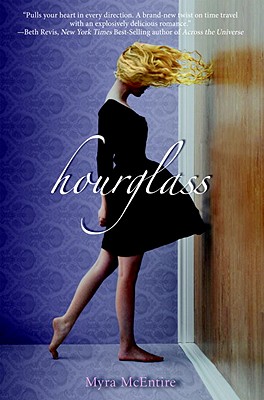
Hourglass


I absolutely adore the cover of Myra McEntire's debut novel, Hourglass. Not only does it have lovely, smooth lines, but for a little while it fools you into thinking the model is being sucked into something . . . and then you realize it's actually a girl, standing on the wall, with gravity obeying its natural course. Go 'head, turn it on the side, and then try to decide what photo magic they used to pull that one off. Photoshop? Wires? Giant wind machine? TIME TRAVEL?

Oh, right; that's what the book's about. Or more accurately, things of the past visiting a quite present Emerson Cole. Or maybe they're ghosts? Maybe Em's psychic and sees dead people? Whatever the answer, the situation is trippy.

Enter the uber-hot Michael (such a popular name for uber-hot characters). Tell us what he wants, what he really, really wants. What's he need, that Michael boy? History rewritten, that's what. Also? Em, because they are science-fictionally two halves of one whole. But do they belong together? Maybe. Maybe not. Because, you see, there's someone else in Emerson's future . . . 

The cover blurbs suggest the book induces all sorts of mood swings in the reader, and this is true, especially in the final fifty pages. Even I, a "first hero met should get the girl" loyalist, don't completely root for one boy over the other by much. Even I can see the wisdom and merit of a specific someone else winning that war, other than Michael. McEntire has done a fantastic job forcing me to consider the alternative, without embittering me toward it. That takes some mad skills, to sway a girl like me. I can only admire it and hope to learn from it.

I say this with a bit of a admission: Hourglass is a book . . . how to put this? Well, sometimes I felt myself reading a scene or a bit of narrative and feeling either proud or a little wary, because it's written so much like I myself would have written it. So that may mean I'm biased when I say I think either a Buy or Borrow appropriate.  The book isn't the most prime example of fantastic writing ever known to man, but it's entertaining, an emotional rush, and leaves you thinking about it hours later, which means it delivers on exactly what it promises.

Thursday, September 1, 2011

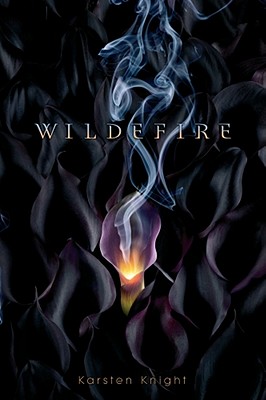
Wildefire


Wildefire by Karsten Knight

Amethyst


Dude. No, Seriously. Dude. In case you wonder if I'm one of the "several people" mentioned below in Michelle's review who disliked the level of violence, rest easy. I'm cool enough with that. The GD-bomb being dropped on the first page I wasn't exactly happy about, or with the following profusion of profanity, but that wasn't what burned me on the first 135 pages of Knight's first novel.

In a nutshell, the whole thing up to that point seemed to scream at me, "Trying WAY too hard". Trying too hard to sound like an authentic teen, trying too hard to be "edgy", trying too hard to make the reader empathize with the main character. For the first 135 pages I just kept thinking, "No," and mentally shaking my head. Between the over-compensation and the wealth of passive voice (a personal peeve), I got knocked out of the story more often than I got pulled into it.

And then something changed. Suddenly the writing grew more confident, more comfortable with itself, and the story--which is very cool--began to shine through. Sure, there were still some features that felt contrived, but all in all, once Knight hit his stride, it was all downhill, baby. Easy. And intriguing. And curiouser and curiouser (even if I tagged the villian the second he/she showed . . . assuming the character is the real enemy (oooo!).

That's fantastic.

I will admit the copy I read was an ARC, an uncorrected proof, so my version may not have been the final say in how the book came out. Perhaps Knight tightens up those first several pages. Perhaps he fixes that confusing time-frame/flashback sequence at the end, and for goodness' sake, let's hope he learns to love a closing comma, because the phrasing suffers without it, but mostly, Wildefire has potential. You'd probably be pretty safe BUYING it, or BORROWING it, either way.

P.S. Gorgeous cover.

Michelle

★★★½

I found Karsten Knight's Wildefire a refreshing take on paranormal romance since it deals more with plot and characters than many of the I-loved-you-before-I-even-saw-you books out now.

There were some things I thought the author did well with his debut, and others that were poorly done or that I really didn't like. But the story is compelling, especially since it incorporated gods and mythology from across the globe.

The plot itself—reincarnated gods meeting each other at a private school in the California redwoods—might seem like a rather popular recent middle grade series *cough*Percy Jackson*cough* but this one is completely different in tone and target audience. There is little chance that these two would be mistaken for each other.

The opening sequence is somewhat violent, and though it didn't bother me too much, I've heard from several others who really didn't like it. I saw it as setting up the characters for the rest of the story. The first few chapters are basically back story, there to establish what got Ash to the boarding school, so the subsequent actions seem fitting with the beginning. 

I wouldn't say to necessarily let the first chapter dissuade you from reading the rest of the book, but there is (perhaps worse) violence later on, so it's definitely something to consider.

My biggest peeve, however, was that Ash often sounded masculine throughout the book. I'd originally thought she was a jock tomboy from her actions and dialogue, but later she's described as girly and cute, and those two didn't mesh for me. 

While I enjoyed most of the book, I really struggled with the climax of the story. It felt a bit overblown, like so much was happening that the characters got lost in the action.

I'm hoping the sequel is better because I love the revelation near the end that one character is actually my favorite god in all of human mythology. There are so many ways to have fun with that character.

Friday, August 26, 2011

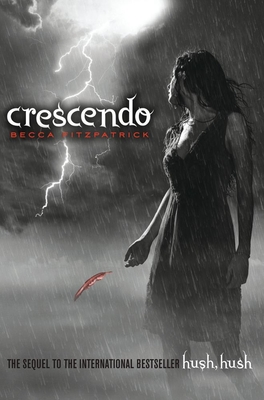
Crescendo


I read Becca Fitzpatrick's first novel, Hush, Hush soon after its release somewhat due to curiosity about the premise, somewhat due to a few teens I know having gushed over it. My general impression was, "Meh," with a shrug of my shoulders. On the one hand, there were some really good elements; a supremely-hot-but-not-entirely-trustworthy boy, creepy bad guys, and a girl who doesn't have much of a clue about what's going on. I can forgive that, but unfortunately, it was all a little too patterned, in a way I've seen all before, so the book--aside from from scorching descriptions of possible boy-toy, Patch--didn't stand out for me.

I can't say the same about Hush, Hush's sequel, Crescendo. It totally stood out for me . . . just not for the kind of reasons one would want. Firstly, main character Nora has not come out of the first book much more informed, but she's honed her ability to whine to a fine point. Whenever boyfriend Patch--with whom she's supposedly soul-mated--fails to deliver what she wants, Nora complains about what a horrible relationship they have, how much she should be pitied, and how Patch isn't sacrificing enough to make their lives more idyllic (despite him having given up his life's dream of getting out of his tortured existence in the previous book, for the sake of his love for her, and becoming her assigned protector, besides).

In the meantime, other lives around Nora are falling apart, but she's too self-centered to noticed, or give those circumstances any attention, except when it benefits her agenda du jour.

Simply put, I just can't like this girl. I'm supposed to. I'm supposed to empathize with her, but it's too difficult when she's got a smokin' boyfriend who adores her, and all she can do is think about what she still wants.

Borrow, if you must, but really? Bypass.

Friday, July 29, 2011

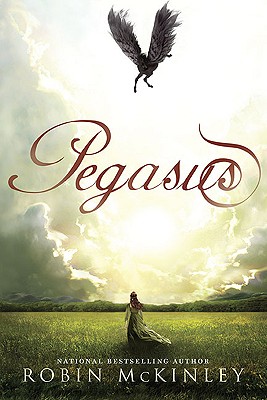
Pegasus


It wouldn't be honest to say Robin McKinley's Pegasus was a fast read for me. In fact, it took me two to three times longer than I'd anticipated.

I can't say it was an easy read, either, as some parts were . . . well, not exactly difficult, but more like tedious.

I can't even simply say I enjoyed the book. I wouldn't say that. Because while the writing was experienced, sometimes extremely evocative, and somehow ripe, there were also places where the writing killed off the story, which is about a young girl (starting out with a genuinely childish twelve-year old, and coming in one of the many "Hurry up and flounder" moves, to fifteen-nearly-sixteen/adulthood) being magically (spirtually? mentally? unusually?) bound to her royal Pegasi counterpart, and what the surprising differences to historical bindings this one poses. Of course there's a bad guy who hates it, a thoroughly bad bad guy we all want to smother in his own supercilious robes, and there are wise monarchs, loving maternal figures, and the much-lauded Third-party-OR-ARE-THEY?!?! threats from great Pegasi-and-human-eating beasts.

There, in fact, 404 pages of these things. Or rather, there are 300 pages leading up to these things, 79 pages of the actual STUFF, and then 20 pages of WHOA, CRAP!, followed by 5 blunt pages of me getting very, very angry, because I--a hardcore devourer of books--have just toiled for at least three-fourths of this book to get to the last page to find . . . nothing.

You remember the Looney Toons wherein Wile E. Coyote would be chasing the Road Runner around, hellbent on (I . . . don't actually know. Did he want to eat him? Take back his pride? Square Dance?) catching that bird when suddenly he finds himself three feet out over the edge of some cliff-edge he'd have sworn hadn't been there two seconds ago? You see it before he does, but then he looks down, looks back up at you, and for the two or three moments he has before he waves, gulps, and begins to fall, you both know the very worst of what's about to happen.

That's page 404 of Pegasus. It's not that I don't like books that leave off in the middle of the action, with no real sense of having accomplished anything--wait, no, that's exactly what it is.  I know I'm always harping about book that could have been tightened up, I guess that's just my style, but if a book takes 400-some pages to just get to the big UH-OH, and then either plans on letting you hang, or means to make you wait for a sequel, my reaction is going to be something to the tune of, WTHades, people!? Cut out 200 pages, put in 200 OTHERS to finish out the frakking story, and let's get a real book out of these pulped trees, already!*

I didn't like the book; I liked the story, but I'm not sure I liked it enough to tip the scales. If you're cool with unnecessarily dense run-around, however well-done, you could borrow this from the library, but otherwise, I advise you BYPASS it.

*I have now looked around to find Pegasus does indeed have an intended sequel, which is good for those who find the ending enough of a cliff-hanger to wait for it, but still doesn't really do anything to change my opinion--so I guess it's good it's purported McKinley herself admits readers will hate her for how the book ends, and she's got a good sense of humor about it.

Thursday, July 21, 2011

Haint Misbehavin'


Haint Misbehavin' by Maureen Hardegree

✭✭✭

I'm a big fan of ghost stories (that don't freak me out too much), and Haint Misbehavin' is a fun one for the middle grade audience. Set in Georgia, there's enough flavor of the South to lend an air of plausibility that the ghost of a young girl from the 1800s would haunt Heather, a modern preteen girl.

While I enjoyed the ghost story, I felt enough rage about the unfair treatment Heather got from her parents and the nasty vendetta of her sister that I couldn't rate it higher.

It's a personal pet peeve, but I abhor books or movies that show unfair relationships toward one child with blatant favoritism of another. (minor spoiler) While the family relationships resolve and are all hunky-dory by the end, (/minor spoiler) there is enough of a bias against Heather that I couldn't relax while reading most of the book. I wanted to jump into the story so I could throttle her older sister. I can't imagine anyone being that cruel to a sibling and their parents turning a blind eye, unless it was a Cinderella situation with the rest of the family being evil. But that's not how this family is portrayed. Were it not for the sibling injustice, they'd be an average American family.

Otherwise, it's an enjoyable story and I look forward to the next book, especially since the sibling rivalry won't be much of an issue in later books. I honestly hope my assessment doesn't prevent people from reading Haint Misbehavin', since it does have a fun ghost story, but as Ames would say, this is a borrow and not a buy.

The next book in the series, Hainted Love, just released in March. By the way, the cover of the second book is much better and will appeal a lot more to preteen girls.

Advance copy provided by the publisher and NetGalley.

Wednesday, July 20, 2011

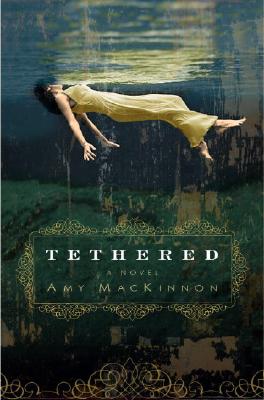
Tethered


There are few books that have done to me what Amy MacKinnon's Tethered has done, which is to take me through a solid, somber tale, leading in a very certain direction and with an expected pleasurable conclusion and then blow it all to hell in the last five pages.

What I thought was going on? Not even. Going back and checking details against what really was happening? Makes TOTAL sense. All of it. A retro "ah-HAH!" moment, or rather, a barage of them, because it was great, and it all fit together like a thousand-piece jig-saw.

And I can't even tell you anything specific about the brilliance, because as River Song would say, "Spoilers!" I suppose I'll need to keep it simple, then.

The narrative--from the perspective of Clara, a withdrawn, somewhat broken undertaker--has a quiet, steady pace, calming even with the often disturbing subject matter. It isn't that Clara regards these things with any sense of flippancy, rather the opposite; her ability to process grief is so underdeveloped it's as if tragedy slides right off of her, until a certain little girl gets under Clara's skin and Clara becomes concerned with the child's home life.

Before it's all over, just about every (living) person in Clara's life is somehow connected to the young girl's circumstances: The compassionate couple who run the funeral home where Clara works, and who consider Clara their child; the older detective assigned to the little girl's case; the younger officer eager to help solve it; and not a few of the former residents of the bodies Clara works on.

Maybe I should have paid closer attention when I put a hold on Tethered with my library, because the novel is labelled "suspense", which might have given me some better idea of what was coming, but then again, maybe not. All I can say about it was that it was awesome.

So, do I recommend you buy Tethered or do I suggest you just borrow it? Well, that depends. How much do you love suspense novels? Are you the kind of reader who appreciates the craftsmanship in a good mystery enough to read it again, even after the mystery is solved, or not? If so, BUY, if not, BORROW. Either way I expect you'll enjoy yourself.

Wednesday, July 13, 2011

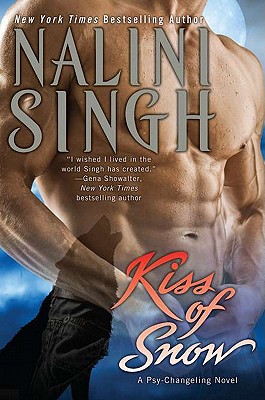
Kiss of Snow


Kiss of Snow by Nalini Singh will do well with the adult paranormal romance series crowd. I had the disadvantage of coming late to the party, so to speak, as I'm not familiar with any Ms. Singh's earlier Changeling/Psy novels and found myself tripping over terminology I'm sure fans of the series would read over without a hitch, but that's my fault, not that of the writing.

Basically, this novel is a solid, interesting-though-format-driven series installment similar in feel to series by Christine Feehan, Sherilyn Kenyon, and Gena Showalter.

Adding personal inspiration and viewpoint to common character templates, Singh creates an alternate universe populated by three main races; changlings (weres of different breeds), Psy (try to twist your brain around a completely biological mesh of ESP-gifted humans and cyborg, with interconnecting consciousnesses), and humans. With these different races comes a bushel of conflict, most of the focus of which covers the friction in interracial romantic relationships. It goes much deeper than skin or culture, ensuring the reader's eagerness to read on, learning more--not only about the resolutions, but even the problems faced by these couples.

While I can't honestly say Kiss of Snow blew me away, I'd definitely recommend it to readers of the genre, or  include the series to a starter list for an adult reader wanting to explore APRs.  This one's right on the line between Borrow and Buy; I probably would borrow it (which, in fact, I did), rather than buy, but I know many readers who would enjoy rereading the book, therefore making it a good purchase for them.

Thursday, July 7, 2011

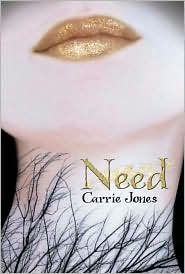
Need and Captivate

Need by Carrie Jones: Book Cover         book cover of 

Captivate 

 (Need Pixies, book 2)

by

Carrie Jones

I've mentioned being a fan of Melissa Marr's Wicked Lovely series, so it's not much of a surprise I'd pick up Carrie Jones's first and second pixie novels, Need and Captivate.


The books follow a pretty basic concept; girl experiences tragedy, moves far from home, realizes she and/or people in her new town aren't exactly normal, and then comes to find out why.

This one was both a hit and a miss for me. Pluses? The narrative flows pretty well, with likable (if sometimes a bit cookie-cutter) characters, some bright points in dialogue, and an interesting turn with looking at Pixies as their own culture, rather than a subset of other faeries, not to mention the inclusion of Norse mythology regarding Ragnarok (the Viking version of the Apocalypse--not just a killer move in Final Fantasy franchise games, who knew??). Negatives involve a lack of real tension, any breakaway character development or world-building, and a shortage of description in certain areas.

Jones's books are a nice, easy read, and would do well to snack on for those whose appetites for Fae fare have gone a while without a richer main course, but as I didn't consider them quite rich enough for my personal tastes, I'm giving the first two books a BORROW. However, who knows; after I've read the third ( and I think--don't quote me--final) book in the series, Entice, I may have to come back and reevaluate. ;)

Sunday, June 26, 2011

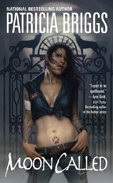
Moon Called: Book One in the Mercy Thompson Series


In short-short, I liked Patricia Briggs's Moon Called. It wasn't my favorite book ever, but it was solid and satisfying, with enough character voice and surprises to keep me happy with the end result, especially for a clear series starter.

I had one nit-pick with it as far as yanking me out of the story, and that was the use and lack of use of contractions in various places. I know, that sounds stupid, but when a reader expects a character to say "I'm" rather than "I am" it gets kind of stumbly.

For a plus point, I particularly liked main character Mercy's pace with revealing information and in explaining her own logistical conclusions.

All-in-all, I give this book a strong Borrow, a Buy if you're really, really into contemporary supernaturals.

On a shallow note, a peeve and praise for the cover designers.

First, the peeve. What mechanic worth her grease would wear her work shirt a). unbuttoned and tied up that way, and b). with a push-up bra? I cannot suspend belief enough to think this covergirl mechanic seriously thinks she'll draw in business this way, even from skeevy rich dudes. Skeevy rich dudes go to strip clubs to see girls in knotted, push-up bra-ed outfits, not garages. Mercy's not stupid; she'd dressed professionally, but for functionality, and so her customers see her as a competent business woman.

However! Kudos to the person who sized and placed the endorsement blurb by Charlaine Harris. It's noticeable without detracting from the cover image, title, or author. That's tasteful and I applaud your class with that issue, Unknown Cover Person.

Sunday, June 19, 2011

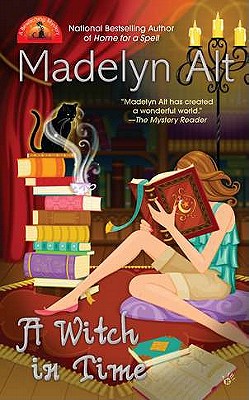
A Witch in Time


A Witch in Time by Madelyn Alt sounded cute and quirky from the flap copy (you know, that little synopsis on the inside of the front cover?), so I picked up from the library and brought it home, along with three other books.

The book lived up to my expectations . . . sort of. I didn't really gel with the beginning, feeling it was a witchy-version rip-off of Charlaine Harris's Southern Vampire novels, but the middle seemed to come together better before unraveling again in the last few chapters.

Maybe its my personal pet peeve about "mystery" books with mysteries so easy to solve it's like watching an episode of Scooby Doo (just wait for the supposedly least likely or capable suspect to show up, and there you've got your criminal), or maybe I can't get passed a heroine who is a). semi-psychic, and b). practically attatched at the hip to other degrees of psychics not to figure things out before I did, especially since the book is from her point-of-view. It felt like Alt kept dumbing down her narrator just to drag out the page-count. Or, it could be I'm miffed there wasn't more hot guy action. That's also possible. Probably, though, all of the above.

One thing I definitely DID NOT dig was where my personal library shelved this book; in Teen fiction. Granted, I have no way of knowing if my library made a individual mistake, or if the book is being targeted to teens and higher, but I really hope it's not the latter. I promise, I'm not being a prude about teens and sex, but I believe if a book is going to deal with teens and sex, it has a responsibility to show both sides of what happens afterwards, and this novel did not do that. The mentions of sex (which were many) had more to do with raging adult hormones had a flippant, no-consequences thing to them, which I think is misleading to anyone, but particularly to teens who are just figuring out for themselves what they feel and believe about love and lust, and that place in between the two.

So, here's the short version: if you don't mind a bit of a wandering narrative and want something fluffy (including the supposed mystery), this is a good book. Think 'beach read' or something to pick up at the end of a long day of fixing fallout from other people's crap. If you want something meatier, something you have to put a little gray matter into, skip this one for a while.

And with this review, I'm instituting a new rating system: MISH! has her stars, but I'm a little more black and white. My three categories will be these: Buy, Borrow, or Bypass. The first is a book I'd rec friends to drop money on, to add to their own library because I believe they'd might reread it several times. Borrow, for those books that are good, and perfectly enjoyable, but probably wouldn't get more than one or two rereads, or be picked up for a special craving. Bypass, obviously means just don't bother, this book would just annoy you to even attempt, and who needs that?

A Witch in Time, by the skin of it's cover, gets a Borrow, mainly due to it being a part of a series, of which other titles could be better.

Thursday, September 16, 2010

Wicked Lovely Series Book Four: Radiant Shadows

Radiant Shadows (Wicked Lovely, #4)

Radiant Shadows , the fourth installment in Melissa Marr's Wicked Lovely series, has some very cool new facets (Steeds!), however it is what it is, which is a vehicle for any finishing touches, additional characters, and other set-up for the fifth book, which completes the series.

I'll admit I'm less invested in any WL storyline not primarily involving my personal favorite characters (Ash, Keenan, Donia, Seth, and Niall), and I'm sure that plays heavily with my 'meh' reaction to the book. I felt it was an unneccessary side-trip away from the "real" story, the brewing wars between the various fey courts. If the series weren't set up for each of its key players to have their own volumes, I'd have said Ani's story could have just about filled in two chapters of another book. However, I did see the need for Ani's love interest, Devlin, to have a book to himself, as he is the tie that binds the two strongest of the conflicting fey courts.
I enjoyed the handling of Ani's struggle to become her own person, even when she didn't fit anywhere, and even more Devlin's internal battles regarding his creators and his feelings for someone not precisely of his home realm. The book had the same dark, sparkling aftertaste of all Marr's novels, which I've always liked, and the new characters it adds to the mix for the upcoming book certainly create a whole new set of variables to the final outcome, so I look forward to that.

This is book is sitting right on the border between Buy and Borrow. If you already own the other series books, add this to your collection, but if the others have already come into and gone out of your life, follow suit and Borrow Radiant Shadows from a library or book buddy.

Saturday, August 8, 2009

Dead is the New Black


Marlene Perez's Dead Is the New Black didn't win me over, and typically I'd just say this was probably better-suited as a middle grade novel, except apparently there might be FACTORS. I hate factors, but they exist anyway. In this case the factor is this: Marlene Perez writes for 'reluctant readers'. Now, I realize I am not a normal person when it comes to reading. I am a reading freak of nature. I know several others, but the general populace is not made up of readers like me. Some people would rather east a vat of spinach swimming in Tabasco sauce rather than read a book. I'm guessing that's Perez's targeted audience, which is why the book is sort of the paint-by-numbers equivilant of the countless vampire novel knock-offs out there. I didn't hate it, but it was so freakin' easy to predict every outcome I resented it for not surprising me at least a little.


So, I guess my  verdict is, if you're a 'reader' better to hold off on this one, but maybe if you have a friend or relative who isn't a reader, you can always pick up a copy and see if they bite. Uh, no pun intended.


Going with Borrow, on the merit of the FACTORS.